
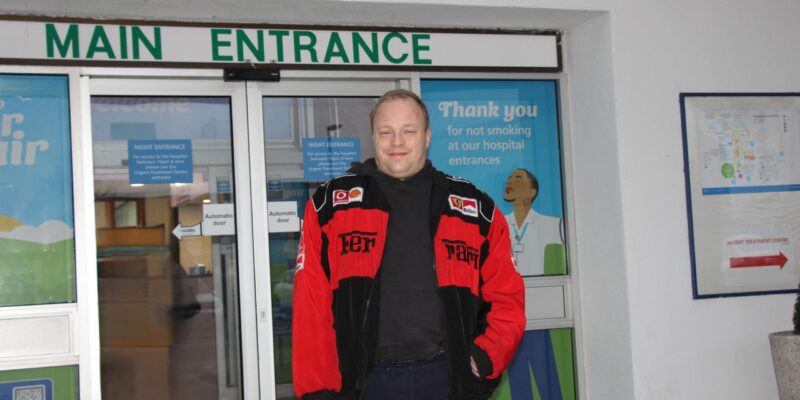
A stroke survivor has credited NHS teams for helping him regain his life after suffering from a stroke – while raising awareness among youngsters that stroke doesn’t discriminate by age.
In October 2025, Matthew Bond, 37, woke up on an early Saturday morning with a ‘pins and needles’ sensation on his left arm. He brushed them off and went back to sleep.
But when he woke up and tried to walk, he felt as though there was a very heavy object attached to his left leg. This was coupled with his left arm going numb and the left side of his mouth dropping, leaving him unable to walk, move or speak.
Matthew’s housemates at the time remembered FAST (Face, Arms, Speech, Time) – an acronym that helps quickly identify the three most common signs of stroke and rang 999.
The North Yorkshire resident was blue-lighted to The James Cook University Hospital for urgent treatment.
Following further scans, Matthew was diagnosed with a right-sided lacunar stroke, an ischemic stroke occurring deep in the brain, and was admitted to the acute stroke ward for four days.
After this, he was transferred to the Rutson Ward at the Friarage Hospital for further rehabilitation.
“One step at a time”
“Having a stroke means that I cannot drive, work and live independently,” said Matthew, who was a former forklift truck driver.
But for patients like Matthew, recovery is crucial after a stroke because it directly impacts a survivor’s ability to regain lost skills, achieve independence, and improve their overall quality of life.
This is when Matthew was referred to the specialist inpatient stroke and complex rehabilitation team on the Rutson unit at the Friarage.
The unit provides care and rehabilitation for patients who have experienced a stroke and other medical conditions as part of their hospital-based recovery.
Clinical lead physiotherapist for stroke and complex rehabilitation Lucy Keenan was involved with Matthew’s care.
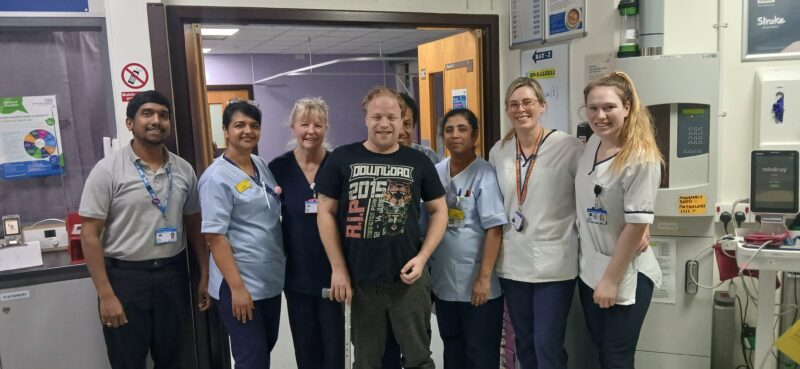
She and her team’s involvement helped him regain his independence, from requiring a hoist and being unable to move to walking freely with a stick, carrying out activities of daily living, climbing stairs, walking outside and returning home.
Thanks to the specialist support, Matthew was discharged from the Friarage after five weeks, during which he was also referred to the early supported discharge (ESD) team – where he received extensive support from the comfort of his home.
Matthew added: “Before being discharged, I met the ESD team who explained to me how they are going to help me as I continue my recovery from stroke.”
Two members from the ESD team visited Matthew three to four times a week over six weeks.
Every visit involved the team members showing the North Cowton resident how to shower safely, introducing different balance and strength exercises whilst undertaking kitchen assessments – ensuring
Matthew was able to lead an independent life again.
“I would like to drive and work again”
Still under the care of the ESD team, Matthew has steadily increased his independence walking, with the aid of a walking stick. He has also been cared for by multiple specialist teams and has one weekly physiotherapy or occupational therapy session at home.
The former forklift truck driver, who has started swimming for the first time after his stroke, is eager to drive and work again and believes the NHS teams would help him achieve these goals.
He said: “The help and support I have received has not only helped my physical recovery but also improved my mental health and wellbeing. The team’s involvement has instilled a sense of hope for recovery and motivation to continue to work on my recovery.”
Lucy added:
On behalf of myself, Kirsty Jones, Liz Haresign, Stephanie Verity and the entire Rutson and ESD team, it has been an absolute pleasure to work alongside and support Matthew on his rehabilitation journey."