

This leaflet is designed to explain what this procedure involves. The examination will be carried out in the X-ray department at the James Cook University Hospital.
What is an aneurysm and an abdominal aortic aneurysm?
An aneurysm occurs when the wall of a blood vessel is weakened and balloons out. In the aorta (largest artery) this ballooning makes the wall weaker and more likely to burst. Aneurysms can occur in any artery, but they most commonly occur in the section of the aorta that passes through the abdomen. These are known as abdominal aortic aneurysms (AAA).
What is an endovascular repair?
An Endovascular Aneurysm Repair or EVAR is done by putting a graft into the aneurysm (where the blood vessel is weakened). The surgeon does this by going into your blood vessels through small cuts (incisions) in your groin. To guide the surgeon, they use X-rays to see where they are going and to guide the graft into the right place.
A stent-graft is a metal mesh-work tube covered by the same material that would be used in open surgical repair.
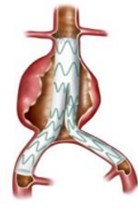
This tube usually divides into two limbs at its lower end, like trouser legs. The stent-graft is inserted into the aorta through the femoral arteries (main arteries to the legs), through two short incisions (cuts), one in each groin. It is then positioned and released across the aneurysm and seals the aneurysm at the top and bottom. This relines the aorta from the inside and prevents blood from flowing into the aneurysm and causing further enlargement and rupture.
Before your procedure
Pre-assessment
Before you are admitted for surgery you will be seen by a specialist nurse and an anaesthetist in clinic. We will take a detailed medical history, as well as perform blood tests, a physical examination, blood pressure checks and a heart trace (ECG).
The anaesthetist will talk to you about your anaesthetic and how your pain will be controlled. You should bring in a list of the medications you take and when you take them. We will let you know if you need to make any changes to your medication for your surgery.
You will also be asked to fill in a questionnaire for the therapy team to help identify if you may need any help or support after the operation. If you do then a member of the therapy team may contact you before you come into hospital. You will also be given information on local services which may be useful to you.
Coming into hospital
You will normally be admitted to the ward or Surgical Admissions Department a few hours before the procedure to check your general health and carry out any necessary tests.
If you have any worries or questions at this stage do not be afraid to ask. We would like you to be as relaxed as possible and do not mind answering any of your questions.
When you come into hospital there are a few items that you should bring:
- All your medications (including insulins and inhalers).
- Nightwear and changes of clothes.
- Toiletries.
- Dentures, glasses and hearing aids if you have them.
Bring them in a small bag labelled with your name. There is not much storage space on the ward so it should only be a small bag.
We recommend that you leave valuable items at home; especially as you will be asked to remove jewellery prior to surgery. The ward cannot accept responsibility for items left on the ward and not handed to the cashiers for safe keeping.
The procedure
You will be brought from the ward to the Interventional Radiology suite at your appointed time. EVAR is sometimes performed under a general anaesthetic (asleep) or spinal anaesthetic (awake) both are administered by an anaesthetist within the Interventional Radiology suite. EVAR is performed through small holes in each groin while X-rays are used to guide the Surgeon and Radiologist during the procedure.
The swollen artery in the abdomen is relined from the inside using a series of covered stents, which are special devices made of covered metal mesh that are placed across a narrowing or blockage to keep the artery open. This prevents the AAA from getting bigger and removes the risk of it bursting.
After the procedure you will usually return to a ward where it is important that you lie flat so that the puncture site does not bleed again. The nursing staff will check the puncture site and take your pulse and blood pressure at regular intervals.
Recovery
- Pain. The wounds in your groins could be uncomfortable at first so you will be offered pain relief. The pain should improve over time.
- Eating and drinking. Once you are awake you will be allowed to eat and drink. You may find you are not very hungry at first but it is important to eat regularly to help your recovery.
- Moving around. Moving around soon after surgery will help speed up your recovery and prevent complications. Deep breathing and coughing exercises help to prevent chest infections so it is important that you do these. The ward staff will help you to regain your normal mobility. Moving around will not cause any damage to the surgical sites. You will be encouraged to maintain as much independence as possible with your personal care and toileting during your recovery.
- Your wound. There may be a dry dressing over your wound. This can be removed after a couple of days. Very occasionally special dissolvable stitches are used to close the wound.
Following your surgery, you may have some swelling and bruising.
This is normal and it will disappear within a couple of weeks. When you are resting, keep your legs up on a stool with your heels clear and your feet ideally higher than your knees.
This is to help reduce the swelling in your legs after the operation. If your wounds become red, sore or are oozing please let your GP know, as this could be a sign of an infection.
After uncomplicated endovascular repair
Once you are up and about, you should be able to leave hospital, but may need painkilling tablets for up to a week.
Patients who have had this repair say that they are usually fully recovered within a couple of weeks.
During this time, you should gradually build up your level of activity back to normal. You may resume normal sexual relations as soon as you as you feel comfortable.
When can I return to work?
Most people who are treated with endovascular repair can return to work within a month after having surgery.
Are there any risks or complications?
The team will talk to you individually. All risks and complications are explained before the procedure and before you sign your consent form. Please do not hesitate to ask any questions you may have.
An EVAR is often deemed safer than a conventional open abdominal aortic aneurysm repair, however as with any operation there are risks involved which vary according to your health but typically include:
Heart attack (uncommon)
Surgery can expose the body to stress which can lead to a heart attack. During the pre-assessment process the nurses and doctors will assess and optimise your heart prior to surgery.
Kidney injury (uncommon)
We use an iodine dye (contrast) to fill the arteries so that we can see them more clearly on an X-ray screen. This dye is very safe but can occasionally affect kidney function, particularly if there is already some kidney damage. The blood tests performed before the procedure will show this. Intravenous fluids and medication can be given before and after the procedure to try to reduce this risk.
Large bruise / haematoma (uncommon)
Sometimes bleeding can occur under the skin where the catheter is inserted. In severe cases this may involve further surgery.
Re-interventions (uncommon)
Around 1 in 10 patients will need to have a further smaller operation in the future if a leak is detected around the stent at your follow-up scan. We will take further scans to ensure all is well. These are usually performed annually but may be more frequent if needed.
Infection (very rare)
Skin infections can occur and be treated with antibiotics. Graft infections, which thankfully occur very rarely (less than 1% of cases), would require further surgery.
Risk to life (uncommon)
As with any major operation there is always a risk to life. This is usually extremely rare but is partially dependent on your age, weight and general health. It is important to note that this risk is smaller than the risk of the aneurysm rupturing.
As with any operation there is a small risk of you having a medical complication such as a chest infection, stroke or deep vein thrombosis (DVT). The doctors and nurses will try to prevent these complications and to deal with them rapidly if they occur. We will be happy to discuss these risks with you, or answer any questions you may have.
For further information you may wish to visit the Vascular Society website and look at the ‘patients’ sections. However as this is not our websites, we cannot guarantee the content.
Radiation dose and risk
X-rays use ionising radiation which can cause cell damage that may, after many years or decades, turn cancerous. The risk of this happening is very small compared to the normal lifetime risk of developing cancer which is 1 in 2.
We are also all exposed to background radiation every day. The risk of long-term effects is considered when the healthcare team decide whether someone needs an X-ray examination and radiation doses are kept as low as possible.
For this examination radiation dose levels are typically equivalent to around 1 to 2 years of background radiation. The associated risk is less than 1 in 1000 – Low.
Is there anything I should tell the staff?
For patients who have ovaries and are between the ages of 12 and 55, the X-ray department has a legal responsibility to ensure that this examination is performed within TEN DAYS of the first day of your menstrual period.
Contact numbers
If you need further advice, or have any problems, please contact the appropriate number below:
James Cook University Hospital
Vascular Team
Telephone: 01642 850850
Monday to Friday, 8:00am to 4:30pm
Email: [email protected]
If you have any worries or concerns, you should contact your GP during normal surgery hours. Outside surgery hours, you should contact your GP’s surgery for the Out of Hours Service number.
Further information is available from:
Patient Experience Team
South Tees Hospitals NHS Foundation Trust would like your feedback. If you would like to share your experience about your care and treatment or on behalf of a patient, please contact The Patient Experience Team who will help you to do this.
This service is based at James Cook University Hospital but also the Friarage Hospital in Northallerton, our community hospitals and community health services.
South Tees Hospitals NHS Foundation Trust
Telephone: 01642 854807 / Freephone: 0800 0282451
Email: [email protected]
Monday to Friday, 9:00am to 4:00pm
Out of hours if you wish to speak to a senior member of Trust staff, please contact the hospital switchboard (numbers below).
James Cook University Hospital
Marton Road
Middlesbrough
TS4 3BW
Telephone: 01642850850
The Friarage Hospital
Northallerton
North Yorkshire
DL6 1JG
Telephone: 01609 779911
This leaflet can be made available in other formats including large print, CD and braille and in languages other than English, upon request.
Patient Information ID number: PI086 version 1
Review Due: 15 June 2029