

1.0 Introduction
South Tees Hospitals NHS Foundation Trust (STHFT) are required to carry out Gender Pay Gap (GPG) reporting under the Equality Act 2010 (Gender Pay Gap Information Regulations 2017).
It is important to understand that gender pay gap and equal pay are two distinct concepts:
Equal Pay is concerned with male and female employees earning equal pay for the same jobs, similar jobs or work of equal value.
The Gender Pay Gap is about the difference between male and female employee’s average pay within an organisation.
Reporting the Gender Pay Gap involves carrying out six calculations that show the difference between the average earnings of male and female employees within STHFT. It does not involve publishing individual employee data.
2.0 Gender profile
As at the snapshot date of 31st March 2025.
STHFT employed 10,857 employees.
The overall gender profile for STHFT is reported as:
- Male: 19%
- Female: 81%
When compared against the NHS as a whole, the national average which reports female representation at 76% and male at 24, the gender profile shows that female representation is 5% higher within STHFT.
3.0 Gender pay gap
3.1 Mean and median analysis
The gender pay gap measured by the median hourly rate is calculated as the mid-point of the salary distribution range for male and female employees.
The gender pay gap measured by the median hourly rate is:
21.14 % for STHFT (this has shown a 0.27% positive decrease on the previous year)
| Gender | Average hourly rate | Median hourly rate |
|---|---|---|
| Female | £17.64 | £18.88 |
| Male | £25.35 | £14.89 |
| Difference | £7.72 | £3.99 |
| Pay gap % | 30.44% | 21.14% |
Table 2. Pay gap by mean and median hourly rate
To calculate the mean (average) hourly rate, earnings are totalled and then divided by the number of male and female employees.
The gender pay gap measured by the average hourly rate is 30.4% (an increase of 1.36% since the previous year)
A summary showing the position for the previous five years as at 31 March (2021 – 2025) is contained at Appendix 1 in this report.
3.2 Quartile reporting
The table below illustrates the gender distribution in STHFT across four equally sized pay quartiles. The values for 2024 are shown in brackets.
| Quartile | Female | Male | Female % | Male % |
|---|---|---|---|---|
| Upper quartile (Q4) | 1719 (1758) | 817 (799) | 67.78% (68.75%) | 32.22% (31.25%) |
| Upper middle quartile (Q3) | 2273 (2133) | 291 (278) | 88.65% (88.47%) | 11.35% (11.53%) |
| Lower Middle quartile (Q2) | 2141 (2105) | 366 (379) | 85.40% (84.74%) | 14.60% (15.26%) |
| Lower quartile (Q1) | 2094 (2083) | 440 (400) | 82.64% (83.89%) | 17.36% (16.11%) |
Table 3. Gender distribution by pay quartile
3.3 Where is the pay gap?
The increase in the mean (average) gender pay gap can be attributed to a number of factors:
- A slight decrease in the representation of female employees in the upper and lower quartiles (Q4 and Q1), resulting in an increase in female representation in the middle 2 quartiles (Q3 and Q2).
- The difference in average hourly rate between male and female staff has increased – resulting in an increase of £0.99 difference between male and female average salary of £6.73 in 2023/24 to £7.72 in 2024/25, therefore resulting in an overall increase.
The changes in the quartile representation are:
- A decrease in the headcount of female employees in Q4: down 0.97% from 1758 employees in 2024 to 1719 employees in 2025. The male equivalent was an increase of 0.97%
- A decrease in the headcount for female employees in Q3 from 2133 in 2024 to 2273 with an overall increase in the % headcount of female employees in Q3: up 0.18% from 88.47% in 2024 to 88.65% in 2025.
- An increase in the headcount of male employees in Q3 from 278 in 2024 to 291 employees in 2025, but overall saw a decrease of 0.18%.
- An increase in the headcount of female employees in Q2 from 2105 in 2024 to 2141 employees in 2025 with an increase of 0.66%. The male equivalent was an increase of 0.66%.
- A slight increase in the headcount of female employees in Q1 from 2083 employees in 2024 to 2094 employees in 2025, but an overall decrease of 1.25%. The male equivalent was an increase of 1.25%.
3.4 Impact of consultant medical and dental staff
There is a greater proportion of male workers within the categories of medical and dental (M&D) and very senior manager (VSM). These roles are the highest paid workers of across the organisation and equate to 6.57% of the total workforce.
This information has been broken down further to show the impact of medical staff on the Trust’s gender pay gap and this shows that if we exclude medical staff, the gap is dramatically reduced.
2024-25 medical staff
| Gender | Average hourly rate | Median hourly rate |
|---|---|---|
| Female | £43.41 | £45.69 |
| Male | £46.22 | £47.03 |
| Difference | £2.81 | £1.34 |
| Pay gap (%) | 6.08% | 2.84% |
Table 4. 2024 to 25 medical staff pay gap reporting
2024-25 non-medical staff
| Gender | Average hourly rate | Median hourly rate |
|---|---|---|
| Female | £16.56 | £14.89 |
| Male | £16.97 | £13.99 |
| Difference | £0.41 | £0.90 |
| Pay gap (%) | 2.41% | -6.40% |
Table 5. 2024 to 25 non-medical staff pay gap reporting
An overall average (mean) pay gap of 2.41%, when medical staff are excluded.
The quartile with the highest representation of male employees is the Upper Quartile (Q4), which represents the highest paid employees of the organisation.
Of the 817 male employees within Q4, 49.8% (407) are medical Consultants. There are 189 female medical Consultants, which accounts for only 11% of the 1719 female employees in Q4. We have seen a small 0.37% decrease in female consultants which was reported at 32.07% in 2024 to 31.70% in 2025.
The imbalance in these numbers has an impact on the overall gender pay gap.
3.5 Pay band review
The proportion of females and males employed within each pay band is shown in the chart below. This illustrates the proportion of female and male staff within each of the pay bands
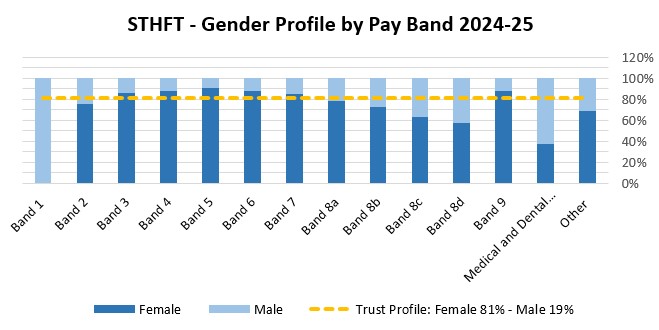
It can be seen that a number of the pay grades are broadly representative of the Trust’s gender ratio (81:19), however there is higher female representation employed in bands 3-7 and higher male representation at bands 1, and for medical and dental staff.
All employees of the Trust, with the exception of medical and dental staff (M&D) and very senior managers (VSM) are paid on national Agenda for Change (AfC) pay, Terms and Conditions of Service.
The Terms and Conditions set out the band structures and pay for all employees to ensure transparency, fairness and equal treatment for all.
4.0 Bonus pay gap
This section of the report is focused on the Gender Bonus Pay Gap %. This is reported as being an average of:
40.76% for STHFT (a decrease of 21.06% since the 2024 report)
The Trust does not operate a bonus scheme, however Consultant Medical and Dental staff were eligible to apply for clinical excellence awards (CEA), which are considered to be a bonus payment and therefore form part of the gender pay gap calculations.
Since agreement of the national pay award for medical Consultants, CEA’s have now been suspended to new applications. Moving forward the Trust is still required to pay CEA payments that were historically awarded to Consultants prior to the 1st April 2018, these are protected until they have terminated their employment, therefore it is not possible to control or influence our bonus pay gaps due to the continuing historical CEA payments.
The tables below provide a breakdown of the average mean and median rate of bonus pay (CEA’s):
| Gender | Means bonus pay | Median bonus pay |
|---|---|---|
| Male | £7,307.95 | £6,032.04 |
| Female | £12,335.92 | £3,141.02 |
| Difference | £5,027.97 | £2891.02 |
| Bonus pay gap | 40.76% | 47.93% |
Table 9. Average mean and median rate of bonus pay
The average gender bonus rate of pay is reported at 40.76% for 2025, which has shown a decrease of 21.06% from the previous year, this was due to bonus payment which was awarded to all staff in 2023/24.
The median difference is reported at 47.93%.
4.1 Where is the average bonus pay gap?
The historical CEA awards have been paid to a total of 112 male Consultants and 24 female Consultants.
The Trust’s Consultant medical workforce are predominantly male; therefore, it is unsurprising that the Gender Bonus Gap % indicates that male Consultants earn a higher rate of average bonus pay (CEAs) than female Consultants.
This is because there are more male Consultants employed by the Trust and more male Consultants who are in receipt of a historical CEA than female Consultants.
5.0 Benchmarking
The NHS as a whole does not undertake national reporting of the Gender Pay Gap, however the information for each individual NHS organisation is available online via the Government’s equalities office.
All Trust’s within the ICS have published their Gender Pay Gap data for 2023-2024 and no Trusts have published data for the 2024-25 report, although it is noted that the deadline for our reporting is not until 30 March 2026.
In respect of the Average Hourly Rate of Pay, all NHS organisations within the ICS report that male employees receive a higher average rate of pay when compared to female employees.
6.0 Actions to address our gender and bonus pay gap
Our actions to improve the Gender Pay Gap across UHT align with the wider organisational strategic goals, specifically ‘Valuing our People’. They also support our commitments to the NHS People Plan.
We continue to commit to address our gender pay gaps and we will look to implement the following actions:
- Develop initiatives as part of our talent management plan to support more women in senior roles, particularly amongst the medical and dental workforce. To narrow the gap, we need to focus on increasing the proportion of women staff in the upper pay quartile, particularly women consultants.
- Continue to apply the national NHS pay frameworks of Agenda for Change (AfC) and conditions for medical and dental staff. This will continue to ensure that job descriptions are evaluated using the national job evaluation system to determine appropriate pay bandings and assure equal pay for equal roles. This system reduces the risk of any equal pay issues arising
- Analyse the data in terms of intersectionality and to drill down the data further to identify any specific trends
- Analyse NHS Staff Survey data, particularly focussing on the experience of women.
- We will continue to encourage our senior leaders to role model working flexibly and to champion flexible working arrangements.
- The Trust is committed to tackling health inequalities. Our workforce health and wellbeing procedures, policies and our strategy will all contribute to closing the gender pay gap by understanding and tackling the inequalities faced by women belonging to specific groups, based on characteristics such as ethnicity, age, deprivation and profession.
- We continue to promoting and updating workforce policies in line with current best practice to promote gender equality, fairness and health literacy.
- The Women and Men’s network offers a place for staff to come together, share experiences and facilitate learning and development. The network will also assist in the shaping and delivery of organisational strategy and policy, working with us to improve staff experience on specific gender related issues and adding more depth to our Gender Pay Gap Action Plan.
- Further analyse is to be reported on the Ethnicity and Disability Pay Gap and further breakdown of data relating to intersectionality.
Appendix: Gender pay gap reporting – five year analysis
| Report indicator | 2020 | 2021 | 2022 | 2023 | 2024 | 2025 | Difference for 2025 |
|---|---|---|---|---|---|---|---|
| Difference in hourly rate of pay Mean (average) | 31.5% | 31.9% | 29.37% | 29.18% | 29.08% | 30.44% | +1.36% |
| Difference in hourly rate of pay Median (middle) | 19.5% | 19.2% | 22.98% | 21.35% | 21.41% | 21.14% | -0.27% |
| Difference in Bonus Pay Mean (average) | 37.3% | 27.9% | 3.11% | 33.71% | 61.82% | 40.76% | -21.06% |
| Difference in bonus pay Median (middle) | 12.5% | 24.8% | 0.00% | 0.00% | 7.41% | 47.93% | -40.52% |
| % of male employees who received bonus pay | 19.8% | 8.4% | 15.0% | 15.8% | 72.85% | 5.37% | -67.48% |
| % of female employees who receive bonus pay | 0.4% | 0.4% | 1.5% | 1.63% | 84.93% | 0.27% | -84.66% |
| Upper Quartile (Q4) male | 31.4% | 31.6% | 32.5% | 32.2% | 30.9% | 32.22% | +1.92% |
| Upper Quartile (Q4) female | 68.6% | 68.4% | 67.5% | 67.7% | 69.1% | 67.78% | -1.92% |
| Upper Middle (Q3) male | 12.80% | 12.32% | 11.49% | 9.62% | 12.27% | 11.35% | -0.92% |
| Upper Middle (Q3) female | 86.30% | 87.20% | 88.70% | 88.73% | 88.27% | 88.65% | +0.38% |
| Lower Middle (Q2) male | 12.26% | 11.07% | 11.23% | 10.06% | 12.20% | 14.60% | +2.40% |
| Lower Middle (Q2) female | 88.40% | 87.30% | 87.5% | 85.62% | 85.99% | 85.40% | -0.59% |
| Lower (Q1) male | 16.60% | 12.70% | 15.50% | 15.40% | 16.73% | 17.36% | +0.63% |
| Lower (Q1) female | 83.40% | 84.30% | 84.50% | 84.60% | 83.27% | 82.64% | -0.63% |
Five year analysis.