

It usually takes a few months for your body to adapt to the changes after surgery. During this time, it is very important that you receive adequate nutrition to aid your recovery and promote wound healing.
The following information aims to explain your nutritional plan following the surgery and explain how the operation is likely to affect your dietary intake.
Partial Gastrectomy
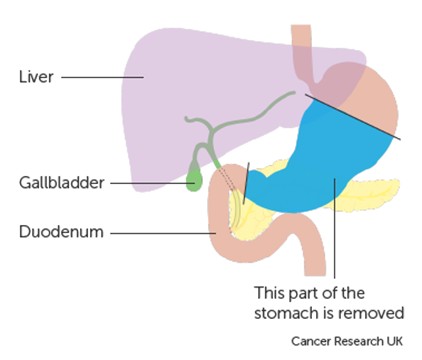
Your surgeon may remove up to two thirds of your stomach if the cancer is at the lower end of your stomach. This is called a subtotal or partial gastrectomy.
How much the surgeon removes depends on the position of the cancer. The surgeon will also remove part of the sheet of tissue that holds the stomach in place (omentum).
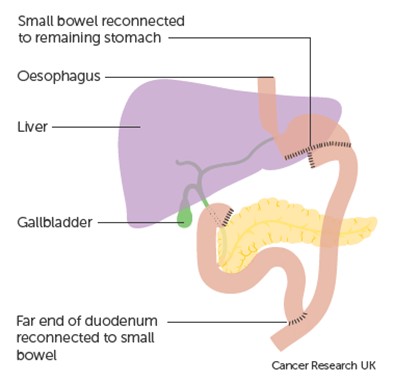
The surgeon joins your small bowel to the remaining part of your stomach. The duodenum is the first part of your small bowel which connects to the stomach.
The surgeon reconnects the far end of the duodenum to the small bowel.
You will have a smaller stomach afterwards. The valve (cardiac sphincter) between your oesophagus and stomach will still be there.
Total Gastrectomy
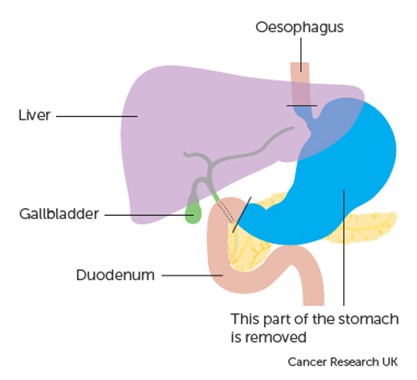
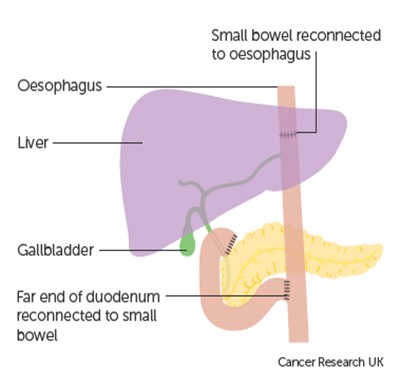
This is when your whole stomach is removed. Your surgeon will re-join your oesophagus to your small bowel.
Nutrition after your surgery
- Sometimes the surgeon will place a feeding tube into your small bowel, known as a ‘jejunostomy tube,’ during the operation. This is more commonly used if you undergo a total gastrectomy. This is used for feeding from the first day following the operation. It allows us to give you nutrition early in the post-operative phase, which has been shown to improve outcomes and recovery. Your feeds will slowly be increased to meet your nutritional requirements after 4 to 5 days.
- You will be nil by mouth (NBM) for approximately 3 to 4 days following your operation to allow the surgical join to heal. At this point, you may or may not have a water-soluble swallow test to establish whether you can start drinking fluids by mouth. If the test is ok, you will usually start sips of fluid and gradually build up your fluid intake over the next few days, until you are drinking freely at around a week after the operation.
- Once fluids are established and tolerated, you will be started on a ‘liquid diet,’ consisting of small amounts of soup, ice cream, yogurt, jelly and mousse.
- You will then progress on to a ’light diet’ consisting of the above ‘liquid diet’, plus foods like omelettes, mashed potatoes, fish pie, cornflakes or porridge. At this point, the volume of your jejunostomy (jej feeds) feeds will usually be reduced, to allow for the introduction of food.
- Initial portions of food should be small, aiming for a ¼ to ½ of your usual intake. Do not worry about finishing your plate. It is important to listen to your body and recognise feeling full when eating meals.
- The initial light diet should be increased to soft options after the first few days of oral intake, so at the point of discharge you should be able to manage small amounts of soft diet, for the next 4 to 6 weeks.
Post operation side effects
- It is very common to have a poor appetite after the operation due to the reduction in stomach capacity.
- Portions need to be small and regular, aiming to eat around 5 to 6 times a day. As your intake is limited, foods need to be high in calories and protein to help with the body’s repair and recovery.
- It is important to listen to your body and recognise feeling full when eating meals. The amount you can eat comfortably, will increase with time.
- Avoid drinking with your meal, have drinks thirty minutes after main meals and in between meals or snacks.
- Weight loss is very common following total gastrectomy, and our aim is to avoid this to help with your recovery.
- Swallowing problems can occur immediately following the operation or sometimes in the months following. Softer foods are advised initially. If this continues, please contact the upper gastrointestinal (UGI) specialist nurse or dietitians for further advice.
- Your altered digestive system means food can sometimes pass through to the small intestine too quickly, and this can cause something known as ‘Dumping Syndrome.’ Symptoms can include sweating, feeling faint or dizzy, nausea, abdominal cramps, shortness of breath, and abdominal pain followed by diarrhoea. Symptoms can be managed by the following:
- Chewing well and eating slowly.
- Eating five to six small meals daily.
- Being aware that foods high in fat and sugar, can increase the symptoms of dumping. If dumping symptoms occur, limit portion sizes of these, and contact your Dietitian for further advice.
- Avoid fluid intake with meals.
These symptoms usually resolve over time.
- A change in bowel habit is common after the operation. Loose stools are a common problem because of your new anatomy, dumping syndrome and reduced ability to absorb your nutrients. Less commonly, you may experience constipation because of a reduced dietary intake, limited fibre intake, and due to side effects of medication.
- Soft foods should be “fork mash-able” for 4 to 6 weeks following your operation. This means they should be soft, tender, and moist and can be mashed with a fork. Use well-fitting lids or foil to cover foods such as cottage pie, hot pots or lasagne whilst baking them, to prevent the top becoming hard and crispy.
Soft diet – recommended foods
Meat and fish and alternatives
Minced or tender meat e.g. beef, lamb, chicken, meatballs, baked or poached fish, eggs, baked beans, soya or meat free mince, meat substitutes e.g. Quorn products or smooth peanut butter.
Fruit and vegetables
Soft fruit (should be mash-able with a fork) e.g., tinned fruit, ripe bananas, berries, avocado, and well-cooked vegetables.
Dairy foods
Milk (this includes milk alternatives such as soya, oat and rice milk), milky puddings, yoghurts, custards, mousses, ice cream and cheese.
Cereals and potatoes
Porridge, wheat biscuits, Rice Krispies® or cornflakes soaked in milk. Soft-cooked pasta, soft rice, soft crackers, soft biscuits, bread sticks.
Foods to be avoided (initially)
All bread and pastry.
Tough gristly meat e.g. sausages, bacon, steak.
Uncooked raw and stringy vegetables e.g. green beans, celery, salad.
Tough skins and coatings e.g. jacket potato skins, chips.
Nuts.
Carbonated drinks.
Enriching your food and drinks
As you are only able to eat small amounts at one time, it is useful to try and optimise the calorie and nutrient content of every meal and snack.
- Choosing high calorie and full fat options of food and drinks where possible and avoiding “diet” or low-calorie products.
- Adding butter, cream and cheese to savoury foods for example soup, mashed or jacket potatoes, scrambled eggs, white sauces or vegetables.
- Adding syrups, jams, honey, sugar and full fat milk to puddings, or cereals.
- Replacing standard milk with fortified milk in hot drinks, cereals, soups, and puddings. To make fortified milk, add four tablespoons of skimmed milk powder to 1 pint of full fat milk.
- Try adding dry, skimmed milk powder into milky puddings, creamy soups, porridge or cereals, and hot milky drinks.
- Choose nutritious drinks in between meals, for example fortified milk or milky hot drinks (hot chocolate, malted milk drinks, milky tea and coffee).
- We would encourage you to focus on establishing food intake following your operation, and therefore avoid the use of nutritional supplement drinks whilst on JEJ feeds.
Nutrient deficiencies
Calcium and Vitamin D: after a gastrectomy, your body may not absorb enough calcium or vitamin D. Calcium is important for strong teeth and bones, and vitamin D helps your body to absorb the calcium.
Good sources of calcium include milk and dairy products, fish with soft bones (pilchards, sardines), green leafy vegetables, pulses. Sources of vitamin D rich foods include margarine, oily fish (pilchards, sardines, herrings, trout, mackerel, and kippers), cereals and eggs. Sunlight is also a good source.
Iron: after a gastrectomy you may develop iron deficiency anaemia because your body is less able to absorb enough iron from food. Iron forms part of haemoglobin, a protein in your blood which carries oxygen around the body.
Good sources of iron rich foods include red meat, liver, fish, egg yolk, green leafy vegetables, pulses, dried fruits, nuts and seeds.
Folic acid and vitamin B12: after a total gastrectomy, your body will not be able to produce a protein called ‘intrinsic factor’. This is needed to absorb vitamin B12 and folic acid from your food. Folic acid and vitamin B12 are required to make new red blood cells and are also important to prevent anaemia.
Your doctor will monitor the levels of vitamin B12 in your blood and give you vitamin B12 injections, roughly every 3 months for the rest of your life.
Rich sources of folic acid are liver, yeast, green leafy vegetables, pulses and fortified breakfast cereals.
Multivitamins and minerals
After surgery to your stomach, your body will find it more difficult to absorb the vitamins and minerals you need to remain healthy. If you have had all of your stomach removed it can be useful to take a multivitamin supplement daily, until your oral intake improves.
We would recommend a complete multivitamin and mineral supplement (A-Z). You can buy these from chemists or large supermarkets. Make sure that the supplement you choose is ‘complete’ and contains the full range of vitamins and minerals, including iron (at least 14mg per tablet).
Here are examples of suitable vitamin and mineral tablets:
- Forceval or Forceval soluble.
- Lloyds Pharmacy A-Z Complete.
- Superdrug A-Z Multivitamin and Mineral.
- Sanatogen A-Z complete.
- Boots A-Z Multivitamin and Mineral.
- Tesco A-Z Multivitamin and Mineral.
(If you are still on an overnight jejunostomy tube feed, you will not need to start taking a vitamin and mineral supplement until this has stopped).
On discharge
- Your jejunostomy tube will remain in place on discharge from hospital and top-up feeds will continue in order to meet your nutritional needs. You will usually be receiving around 50 to 75% of your nutritional requirements through the tube at this point. Training will be provided to show you and your family (if required) how to administer the feeds at home.
- The tube will remain in situ and feeds will continue until your weight is stable and oral intake is adequate. How long this takes varies and will depend on whether you are having further treatment after the operation.
Follow-up
- You will be seen in clinic by the UGI dietitian and the UGI specialist nurse at around 2 to 3 weeks post discharge and ongoing appointments will be arranged thereafter.
- Please complete the 3-day food diary attached, including a rough idea of portions sizes, for the 3 days prior to your appointment, and bring this to your UGI therapy appointment.
N.B. Sometimes there can be variations in post-surgery recovery which can affect your nutrition. Your UGI specialist nurse and dietitians will work together with you closely if these issues arise.
Please note: This leaflet should be used in conjunction with advice from a dietitian.
Contact numbers
If you need further advice, or have any problems, please contact the appropriate number below:
James Cook University Hospital
Dietetics and Nutrition Dept
Telephone: 01642 854777
Monday to Friday, 8am to 4.30pm
Email: [email protected]
UGI Specialist Nurses
Endoscopy unit
Telephone: 01642 282874
Monday to Friday, 8am to 4.30pm
Email: [email protected]
Food and fluid diary
Example of a daily food diary
| Meal | Food |
|---|---|
| Breakfast | Drinks: |
| Morning Snack | Drinks: |
| Lunch | Drinks: |
| Afternoon Snack | Drinks: |
| Dinner | Drinks: |
| Supper | Drinks: |
| Comments | Drinks: |
Different formats
This leaflet can be made available in other formats including large print, CD and braille and in languages other than English, upon request.
Patient Experience Team
South Tees Hospitals NHS Foundation Trust would like your feedback. If you would like to share your experience about your care and treatment or on behalf of a patient, please contact The Patient Experience Team who will help you to do this.
This service is based at James Cook University Hospital but also the Friarage Hospital in Northallerton, our community hospitals and community health services.
South Tees Hospitals NHS Foundation Trust
Telephone: 01642 854807 / Freephone: 0800 0282451
Email: [email protected]
Monday to Friday, 9am to 4pm
Out of hours if you wish to speak to a senior member of trust staff, please contact the hospital switchboard (numbers below).
James Cook University Hospital
Marton Road
Middlesbrough
TS4 3BW
Telephone: 01642 850850
The Friarage Hospital
Northallerton
North Yorkshire
DL6 1JG
Telephone: 01609 779911
Leaflet ID: PI064 version 1
Review due: 18 June 2029